How to Store Moringa Powder in India: A State-by-State Guide for Heat, Humidity and Monsoon
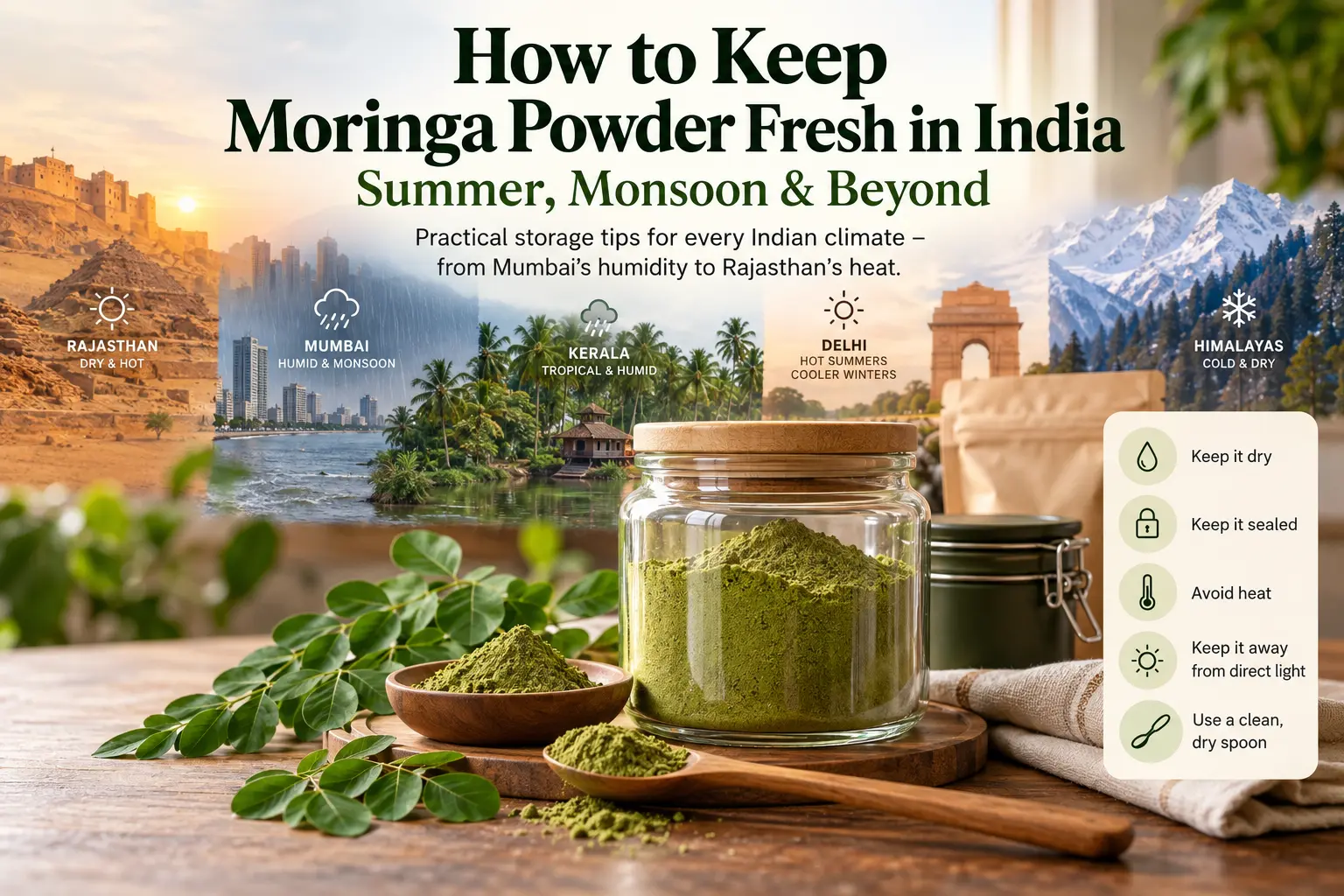
You open your KOVERAAS Organic moringa powder, take out a clean spoon, and notice something has changed.
The powder that was once loose and bright green has started forming tiny lumps.
In another home, the same thing may happen during monsoon. In a hot inland city, the powder may gradually lose some of its fresh colour and aroma. In a cooler northern winter, storage may be much less demanding.
The problem is not necessarily the moringa powder itself.
The Indian climate is the variable.
India stretches from humid coastal regions to dry deserts, from tropical southern states to cold Himalayan areas. A storage method that works well in Rajasthan may not be ideal in Kerala during the monsoon.
For a powdered leafy food such as moringa, the main things to control at home are moisture, heat, light, air exposure and contamination.
Research examining moringa leaf powder has found that storage temperature and packaging can influence colour, phytochemical composition, nutritional characteristics and microbial growth.
First: What Actually Damages Moringa Powder?
Before looking at different parts of India, it helps to understand the main factors that can affect the quality of moringa powder during storage.
1. Moisture
Moisture is usually one of the biggest household storage problems.
Moringa powder is a dry food. When moisture repeatedly enters the packet or container, the powder can lose its free-flowing texture and begin forming lumps.
Moisture can also create conditions that favour microbial growth.
Common ways moisture enters a moringa powder container include:
Using a wet spoon
Opening the package near cooking steam
Leaving the pouch open
Storing it beside the kitchen sink
Keeping it close to boiling water or cooking vessels
Repeatedly exposing the powder to humid monsoon air
A simple dry spoon can make a bigger difference than many people realise.
2. Heat
Indian kitchens can become surprisingly hot during summer.
Long-term exposure to high temperatures can accelerate quality changes in dried plant powders. Research on moringa powder has found greater changes under higher-temperature storage conditions compared with cooler storage.
That does not mean every household needs to refrigerate moringa powder. It means you should avoid deliberately storing it in the hottest part of your home.
Avoid locations such as:
Directly above the gas stove
Beside an oven
Near a microwave exhaust
On a sunny windowsill
Inside a car
On a balcony exposed to afternoon sunlight
3. Light
Moringa's natural green colour comes from plant pigments that can be affected by light and heat.
Research has found greater colour changes when moringa powder is stored at higher temperatures with light exposure.
For everyday household storage, a dark cupboard is generally preferable to a transparent jar sitting on an open kitchen shelf.
Green powder does not need a spotlight.
4. Air Exposure
Every time you open a container, fresh air and potentially moisture enter.
Opening a large 500 g or 1 kg container several times a day is different from opening a smaller quantity occasionally.
For regular household use, it can therefore be practical to keep the bulk quantity tightly sealed and use a smaller portion for everyday cooking.
The Golden Rule for Storing Moringa Powder in India
If you remember only one thing from this guide, remember this:
Keep moringa powder tightly sealed, dry, away from heat and protected from direct light.
For most households, these simple habits matter more than creating a complicated storage system.
How to Store Moringa Powder Based on Your Indian Climate
India cannot be treated as one giant climate zone.
Your storage approach should reflect where you live.
The following recommendations are practical household guidance based on broad regional climate patterns. Conditions can vary considerably within the same state because of altitude, coastline, rainfall, season and local geography.
Kerala, Coastal Karnataka and Coastal Maharashtra
Climate challenge: High humidity and monsoon moisture
Coastal areas can remain humid for long periods, with monsoon conditions making dry-food storage particularly challenging.
Best practice
For households in Kerala, coastal Karnataka, Goa and the Konkan region of Maharashtra:
Keep the pouch tightly sealed immediately after use.
Use a completely dry spoon.
Do not store the powder near the sink or stove.
Prefer properly sealed, moisture-resistant packaging.
During humid monsoon periods, minimise repeated exposure to humid air.
If you transfer the powder into another container, make sure the container is completely dry before filling it.
A useful monsoon habit
Keep only a small working quantity in your daily-use container and keep the remaining supply tightly sealed.
This reduces repeated exposure of the bulk quantity to humid air.
Tamil Nadu
Climate challenge: Heat and regional humidity
Tamil Nadu has considerable climatic variation. Coastal Chennai and interior areas do not experience exactly the same conditions.
During hot periods, avoid storing moringa powder in areas exposed to direct sunlight or kitchen heat.
Best practice
Store it inside a cupboard.
Keep it away from windows.
Keep it away from the stove.
Keep the packaging tightly sealed.
Always use a dry spoon.
Andhra Pradesh and Telangana
Climate challenge: Summer heat and seasonal humidity
Both states experience significant seasonal temperature variation. During summer, kitchen temperatures can become substantially higher than comfortable room temperatures.
Best practice
Keep moringa powder away from direct sunlight.
Keep it away from heat-generating appliances.
Store it inside a closed cupboard.
Keep the package tightly sealed.
During humid periods, be particularly careful about moisture entering the package.
Odisha and West Bengal
Climate challenge: Humidity and monsoon
The eastern coastal belt can experience substantial humidity and seasonal rainfall, making moisture management particularly important.
Best practice
Keep the original pouch tightly sealed.
Use a dry spoon every time.
Do not leave the packet open while cooking.
Keep it away from steam.
Store it in a dry cupboard.
Assam and the Northeastern States
Climate challenge: High humidity and rainfall in many areas
Northeastern India contains substantial climatic diversity, but several areas experience high rainfall and humid conditions.
Here, moisture control should be a priority.
Seal the package quickly after every use.
Keep the powder away from steam.
Never use a damp spoon.
Avoid storing it beside wet ingredients.
Choose a dry, shaded cupboard.
For especially humid homes, an airtight food-grade container can provide additional protection after opening, provided the container itself is completely dry.
Bihar, Jharkhand, Chhattisgarh and Eastern Madhya Pradesh
Climate challenge: Hot summers and seasonal humidity
These regions can experience strong seasonal changes. Summer storage should focus primarily on avoiding excessive heat, while monsoon storage should focus more heavily on moisture.
During summer
Use a shaded cupboard.
Keep the package away from cooking heat.
Keep it away from windows and direct sunlight.
Keep it tightly sealed.
During monsoon
Use a completely dry spoon.
Reseal the package immediately.
Keep it away from steam.
Use moisture-resistant packaging.
Rajasthan, Gujarat and Dry Parts of North-West India
Climate challenge: High heat and sunlight
Dry climates can make people assume that moisture is the only thing that matters less. However, heat and sunlight remain important storage considerations.
A sealed pouch sitting in direct afternoon sunlight can become considerably hotter than the surrounding room.
Best practice
Store moringa powder inside a shaded cupboard.
Keep it away from windows.
Keep it away from hot appliances.
Keep the packaging sealed.
Dry air does not cancel out heat and light.
Punjab, Haryana, Delhi and Western Uttar Pradesh
Climate challenge: Very hot summers and cooler winters
These regions experience noticeable seasonal changes.
Summer storage
Heat becomes the main consideration. Choose a cool, shaded cupboard and keep the package tightly sealed.
Winter storage
Storage can become easier in cooler conditions, but the same basic principles still apply. Keep the powder protected from kitchen moisture and contamination.
Uttar Pradesh and Bihar During Monsoon
Summer and winter conditions can differ considerably from monsoon conditions.
During humid weather, temporarily shift your storage strategy towards stronger moisture protection.
Monsoon checklist
Dry spoon? ✓
Package tightly sealed? ✓
Away from steam? ✓
Dry cupboard? ✓
No direct sunlight? ✓
That simple five-point routine is enough for most households.
Himachal Pradesh, Uttarakhand and Other Himalayan Areas
Climate challenge: Altitude, cooler temperatures and seasonal humidity
Storage conditions vary considerably with altitude and season.
In colder areas, temperature itself may not be the main problem. However, kitchens can still become humid because of cooking, boiling water and indoor condensation.
Do not assume that cold weather means the powder can be stored anywhere.
Keep it sealed and dry.
Also avoid moving a very cold container into a warm, humid environment and immediately leaving it open, as condensation can introduce moisture.
Jammu & Kashmir and Ladakh
Climate challenge: Cold, dry conditions in many areas, with strong local variation
In dry, cold environments, moisture may be less challenging than in coastal India. However, temperature changes and indoor heating can still affect storage conditions.
Keep the product sealed.
Keep it dry.
Keep it away from heating equipment.
Protect it from direct sunlight.
Stable, dry and shaded is better than constantly changing conditions.
Maharashtra: Mumbai, Navi Mumbai, Pune and Beyond
Maharashtra is a good example of why one state should not be treated as one climate zone.
Mumbai and Navi Mumbai
Main challenge: Humidity and monsoon
During monsoon, moisture control becomes especially important.
Keep the packet away from:
Sink
Stove
Steam
Open windows during heavy rain
Damp cupboards
A tightly sealed pouch or airtight food-grade container can be useful after opening.
Pune
Pune generally has a different humidity profile from the Mumbai coast, but hot summer conditions still make heat and sunlight worth considering.
A shaded kitchen cupboard is generally preferable to an exposed shelf.
Vidarbha and hotter inland Maharashtra
Heat becomes a more important consideration.
Store the powder away from direct sunlight and heat-generating appliances.
What About Refrigerating Moringa Powder?
Refrigeration is not automatically required.
If the product is properly dried, packaged and stored according to its label, a cool, dry and dark cupboard may be sufficient for normal household use.
Research indicates that cooler storage can help preserve some measured quality attributes of moringa powder compared with higher-temperature storage. However, refrigeration also introduces another consideration: condensation and moisture exposure.
If you refrigerate moringa powder
Keep it tightly sealed.
Avoid repeatedly opening a cold container.
Prevent condensation from entering the powder.
Follow the storage instructions on the product label.
Should You Transfer Moringa Powder Into a Glass Jar?
You can, but the material itself is not the most important factor.
What matters is that the container is:
Food-safe
Completely dry
Airtight
Clean
Protected from direct light
A transparent glass jar sitting in direct sunlight is not necessarily better than a properly sealed opaque pouch stored inside a cupboard.
What If the Moringa Powder Becomes Lumpy?
A few small lumps do not automatically mean that a product has spoiled. Powder can clump when it absorbs moisture.
However, do not simply crush the lumps and continue using the powder without checking it.
Look for:
Unusual smell
Visible mould
Unusual colour changes
Insect contamination
Dampness
Significant texture changes
Damaged packaging
If you see mould or suspect contamination, do not taste the powder to check whether it is safe.
Discard it.
What If the Colour Changes?
Moringa powder naturally has a green colour, but colour can change with time, processing and storage.
Research has found that higher temperatures and light exposure can contribute to colour changes in stored moringa powder.
A colour change alone does not provide enough information to determine food safety.
Instead, consider:
Colour + smell + texture + packaging condition + storage history.
If there is an unusual odour, visible mould, insect contamination or another clear sign of deterioration, do not consume it.
The KOVERAAS 5-Point Storage Rule
Wherever you live in India, remember these five simple rules:
1. KEEP IT DRY
Moisture is one of the biggest enemies of powdered foods.
2. KEEP IT SEALED
Close the pouch or container immediately after use.
3. KEEP IT COOL
Avoid unnecessary heat, especially during Indian summers.
4. KEEP IT DARK
Protect the powder from direct sunlight.
5. KEEP IT CLEAN
Use a clean, completely dry spoon every time.
You don't need a complicated storage ritual.
A Simple India-Wide Climate Guide
Region | Main Concern | Storage Priority |
|---|---|---|
Kerala & Coastal Karnataka | Humidity + monsoon | Moisture protection |
Goa & Konkan Maharashtra | Humidity + monsoon | Airtight + dry storage |
Mumbai & Navi Mumbai | Humidity + monsoon | Moisture control |
Tamil Nadu | Heat + regional humidity | Shade + cool storage |
Andhra Pradesh | Heat + seasonal humidity | Heat + moisture control |
Telangana | Summer heat | Shade + sealed packaging |
Odisha | Humidity + monsoon | Moisture protection |
West Bengal | Humidity + monsoon | Moisture protection |
Northeast India | Rain + humidity | Strong moisture control |
Rajasthan | Heat + dryness | Protect from heat and sunlight |
Gujarat | Heat + regional humidity | Shade + sealed storage |
Punjab & Haryana | Hot summers | Cool, shaded storage |
Delhi NCR | Summer heat | Shade + airtight storage |
Uttar Pradesh | Seasonal variation | Adapt storage by season |
Bihar & Jharkhand | Heat + monsoon | Heat and moisture control |
Inland Maharashtra | Summer heat | Shade + airtight storage |
Himalayan regions | Temperature variation | Dry, stable storage |
This is a practical household guide based on broad regional climate patterns. India's climate varies considerably within states, so local conditions and the product's storage instructions should always be considered.
How KOVERAAS Customers Can Store Their Moringa Powder
When your KOVERAAS moringa powder arrives, you don't need to do anything complicated.
If the package is unopened
Keep it in its original packaging according to the storage instructions on the label.
Store it in a:
Cool + dry + dark place.
After opening
Open only when you're ready to use it.
Take the required quantity with a dry spoon.
Do not allow steam or water near the powder.
Close the package immediately after use.
Return it to a shaded cupboard.
During monsoon
Be extra careful about humidity and moisture exposure.
During extreme summer
Move the product away from windows, hot shelves, rooftops and cooking appliances.
The Best Storage Location in an Indian Home
If you have to choose between an open kitchen shelf beside the window and a closed cupboard away from the stove, choose the closed cupboard away from the stove.
If you have to choose between a cupboard directly above the gas stove and a dry cupboard away from cooking heat, choose the dry cupboard away from cooking heat.
If you have to choose between a wet
Shop the story
Handpicked from our collection.

